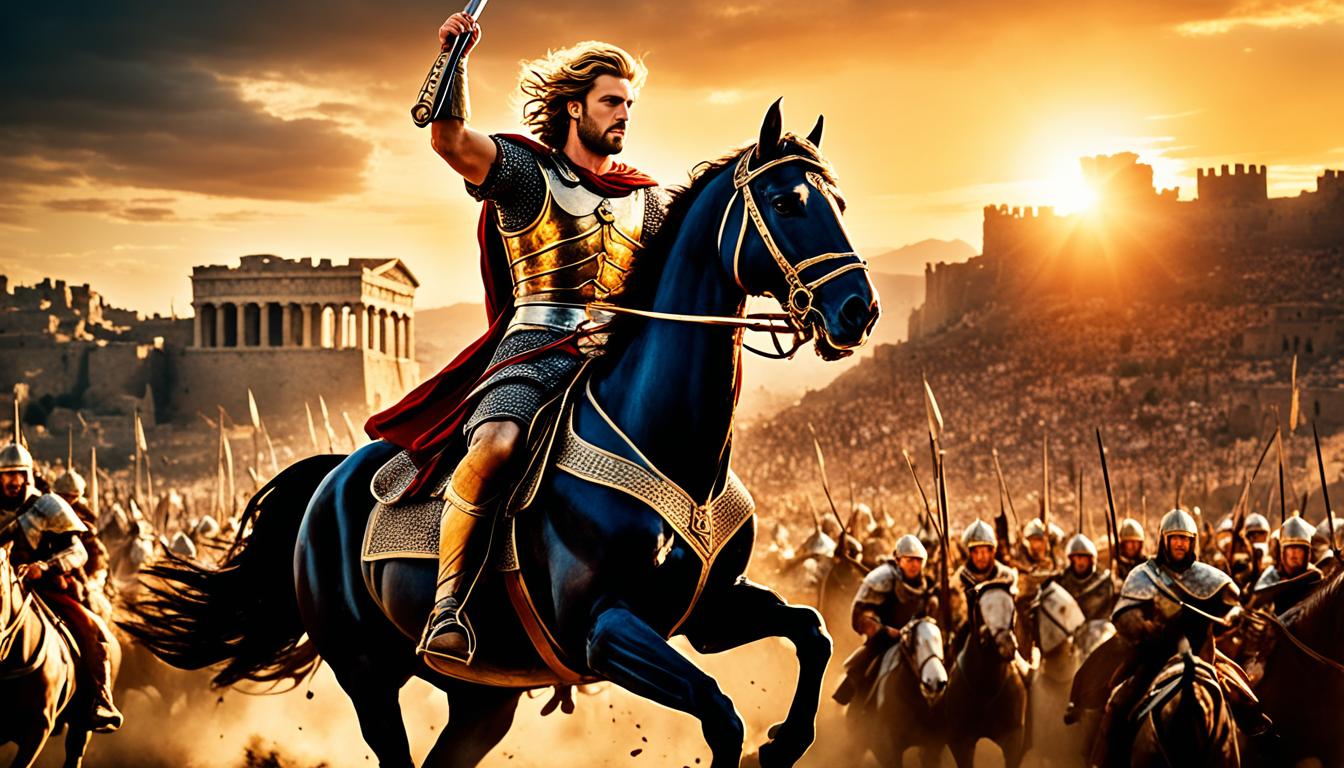
Alexander the Great is known for his epic conquests and building a huge ancient empire. He was born in 356 BC in Macedonia. His life story is filled with daring actions and big dreams. We’ll explore how he became a legend, his military victories, and his lasting impact.
Alexander was eager to learn and had big dreams from a young age. He wanted to be like his dad, King Philip II of Macedonia. He studied with Aristotle, a famous philosopher, to improve his strategic thinking and love for Greek culture.
At 20, Alexander became king and aimed to beat the Persian Empire. This move made him famous as a great conqueror.
Alexander won key battles like Issus and Gaugamela, taking down the Persian Empire. His new military strategies and leadership led to big wins against tough foes. Under him, the Macedonian Empire grew to include lands from Greece to Egypt and up to modern-day Pakistan.
Alexander the Great: A Legendary Conqueror
Alexander the Great was born in 356 BC, destined for greatness. He was the son of King Philip II of the Macedonian monarchy. From a young age, he was trained in military skills and sought knowledge. He learned from Aristotle, a famous philosopher, which sharpened his strategic thinking and deepened his knowledge of the ancient world.
At the Battle of Chaeronea, Alexander showed his military skills. He helped his father win against the Greek city-states. This victory set the stage for Alexander’s rise to power and the growth of the Macedonian Empire.
Military Conquests and Achievements
After his father’s death, Alexander took over the throne. He started a series of military campaigns that made him one of history’s greatest conquerors. He defeated the Persian Empire, showing his strategic and tactical skills.
Alexander’s ambition and drive expanded the Macedonian Empire across the ancient world. His armies moved from the Mediterranean to the Indus River, impacting many cultures and civilizations. His actions changed the course of history.
The Macedonian Empire’s Expansion
Alexander the Great led the Macedonian Empire to a huge expansion from the Mediterranean to the Indus River. His military campaigns made him the top ruler over a vast area. This brought the Hellenistic world’s influence to the conquered regions.
Alexander wanted to be like his hero, Achilles, and beat his father, Philip II of Macedon. He had a strong and skilled army. Together, they started military campaigns that changed history.
The empire grew through many big wins. These included the Battle of the Granicus, the Battle of Issus, and the Battle of Gaugamela. These victories let Alexander take over the Persian Empire, the Levant, Egypt, and parts of India.
As the empire got bigger, Greek culture and technology spread in the conquered areas. Cities like Alexandria in Egypt and Kandahar in Afghanistan were founded. They brought Hellenistic ideas and helped share knowledge between East and West. This started the Hellenistic Age and left a lasting mark of Alexander the Great.
Battles that Shaped History
Alexander the Great’s military campaigns were marked by two key battles – the Battle of Issus and the Battle of Gaugamela. These battles showed Alexander’s strategic skills and made him known as a top military leader of ancient times.
The Battle of Issus
In 333 BC, Alexander’s Macedonians faced the Persian King Darius III’s huge army at Issus. Alexander’s tactics helped him beat the Persians, even though they had fewer soldiers. He used his fast cavalry and surprise to defeat Darius’ forces, changing the course of history.
This battle proved Alexander’s tactical and leadership skills. His ability to lead and make bold moves was key to winning against the Persians.
The Battle of Gaugamela
Next year, in 331 BC, Alexander faced a huge test at Gaugamela. Darius III had gathered a massive army to fight the Macedonians. Alexander’s careful planning and tactics won the day, using infantry and cavalry together to beat the Persians.
This victory ended the Persian Empire’s rule and started Alexander’s empire’s growth. The Battle of Gaugamela made Alexander a legendary military strategist, adding to his historical fame.
Alexander’s Leadership and Tactics
Alexander the Great was a top military leader thanks to his fresh leadership and smart tactics. He led the Macedonian army with skill. He could change his plans to fit the battle and his enemies, making him a legendary conqueror.
Innovative Military Strategies
Alexander’s tactics were known for being new and very effective. He mixed infantry, cavalry, and siege weapons well. This made his army strong and quick, often winning battles even when they were fewer in number.
He used the Macedonian phalanx, a strong group of infantry, in a new way. By combining the phalanx with fast cavalry, Alexander made a strong force. This force could quickly adjust to the battle’s changes.
Alexander’s leadership was key to his military wins. He was a charismatic leader who had his troops’ full loyalty. His bravery and willingness to share the hardships made his soldiers want to win for him.
The Legacy of Alexander the Great
Alexander the Great’s impact on the ancient world is huge. His military wins and the growth of the Macedonian Empire changed history. His influence is still seen today, drawing scholars and sparking ongoing interest.
Alexander spread Hellenistic culture far and wide. As his empire expanded, it took Greek language, customs, and traditions to new lands. This mix of Greek and Eastern cultures created a lively Hellenistic civilization after Alexander died.
His rule also brought about great architectural and engineering feats. Cities like Alexandria in Egypt became centers of learning and culture. They left a big mark on the areas they touched.
Alexander’s military tactics and innovations are still studied and admired. His leadership and tactical skills led to many victories. He’s considered one of the greatest military leaders in history.
Today, Alexander the Great’s story still inspires us, showing up in art, literature, and movies. His life and achievements have been retold many times, making sure his legacy lives on.
Historical Curiosities: Intriguing Facts About Alexander
Alexander the Great’s life was full of oddities and legendary stories. These have kept scholars and historians interested for centuries. He had unusual traits and made amazing military wins. His life is full of stories that still grab our attention today.
Alexander was really into the supernatural. He talked to oracles and seers to get advice for his big plans. He thought he was the son of the god Zeus, which made people see him as more special.

Alexander was also known for acting on impulse, sometimes putting himself and his soldiers in danger. This made him seem bold and daring to his followers.
But Alexander’s life wasn’t just about his odd ways. It was also filled with stories of his bravery and leadership. These stories have made him a legendary figure in history.
The Final Days and Death of Alexander
Alexander the Great, the famous Macedonian conqueror, died in mysterious and sudden circumstances. Historians and researchers are still trying to figure out how he died. The details of his death are not clear.
Theories and Speculations
Many think Alexander died from an illness or disease. Some believe he got malaria or typhoid fever during his battles. Others think he was poisoned by his generals or enemies.
Another idea is that his love for drinking led to his death. Alexander was known to drink a lot. Some think this drinking might have caused his death. But, we’re not sure how much alcohol played a part.
The way Alexander the Great died has always been a big mystery. It keeps historians and the public interested. The mystery makes people want to learn more about his last days.
Alexander’s Influence on Ancient Civilizations
Alexander the Great changed the ancient world in big ways. His military wins didn’t just grow the Macedonian Empire. They also spread Greek culture, ideas, and tech far and wide. After he died, his legacy helped start new Hellenistic kingdoms.
Alexander’s victories changed ancient civilizations in many ways. His wins helped spread Hellenistic culture. This mix of Greek and local traditions led to sharing knowledge, tech, and art. It changed ancient history.
After Alexander died, kingdoms like the Seleucid, Ptolemaic, and Bactrian ones kept this cultural sharing going. They blended Greek and local ways, creating a unique Hellenistic culture. This culture changed the ancient world in big ways, from architecture to science.
Alexander’s influence went beyond his empire’s borders. His wins and the spread of Hellenistic culture shaped societies far away. Today, people still study and admire his impact on the ancient world.
The Hellenistic Age and Cultural Diffusion
The Hellenistic Age came after Alexander the Great’s reign. It was a time of great cultural sharing and mixing of Greek and Eastern cultures. Alexander’s empire spread from the Mediterranean to the Indus River, leading to a sharing of ideas and traditions.
Blending of Greek and Eastern Cultures
This period saw a unique mix of Greek and Eastern cultures. Greek language, philosophy, and art spread far and wide. At the same time, local customs, tech, and beliefs were added to the Greek world.
Cities like Alexandria in Egypt and Seleucia in Mesopotamia became centers of this cultural mix. They drew in scholars, artists, and traders from everywhere. This led to a rich sharing of new ideas and discoveries.
The Hellenistic Age was also a time of big scientific and intellectual leaps. Scholars like Euclid, Archimedes, and Ptolemy made huge discoveries. Their work helped set the stage for future scientific breakthroughs.
Art and architecture from this era were also stunning. Greek styles were adapted to fit local tastes. Famous sculptures like the Winged Victory of Samothrace show how Greek and Eastern art came together.

The Hellenistic Age’s impact is still seen today in Greek language, philosophy, and art. This period of sharing and blending laid the groundwork for the amazing achievements of the Hellenistic civilization.
Cities Founded by Alexander the Great
Alexander the Great changed the ancient world in many ways. He didn’t just win battles; he also planned and built cities. He created a network of cities that became key centers for trade, culture, and government.
One of his greatest achievements was starting Alexandria in Egypt. This city became a center for learning and culture. It was a key spot for trade and a place where scholars gathered.
Alexandria was famous for its Library and the Lighthouse, one of the Seven Wonders of the Ancient World. It was a place where knowledge and culture thrived.
Alexander also left his mark in the Levant, Central Asia, and the Indian subcontinent. He founded or expanded cities like Kandahar in Afghanistan, Ai-Khanoum in Tajikistan, and Bucephala in Pakistan. These cities helped spread Hellenistic culture and influence far and wide.